




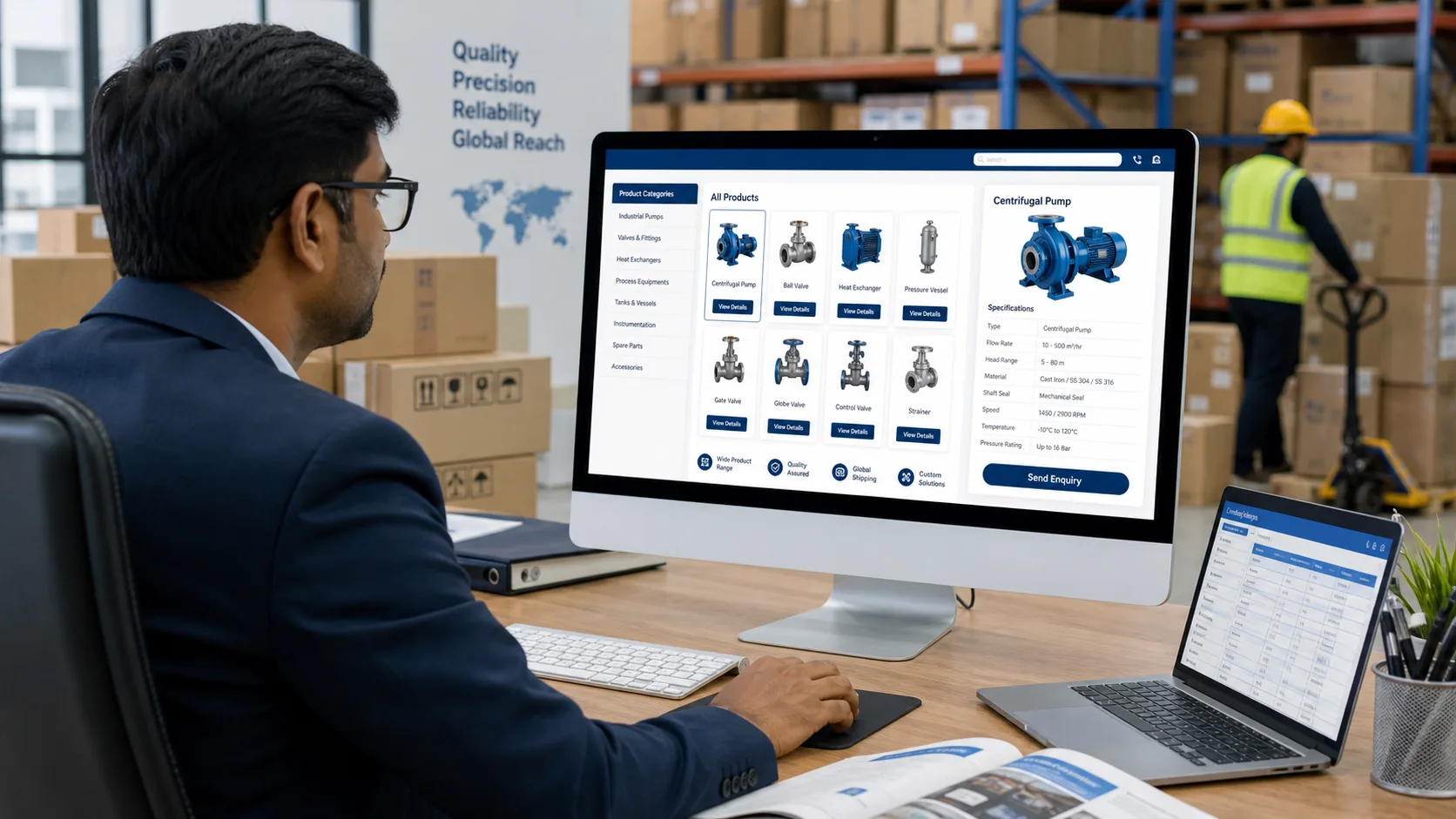

Many manufacturers and traders want to showcase their products online, but they do not always require a full eCommerce website. In many industries, customers prefer to compare products, review specifications, request quotations, or submit bulk enquiries before making a purchasing decision.
For businesses that follow this type of sales process, product catalog website development offers a practical and cost-effective solution.
A product catalog website serves as a structured online product showcase. It enables businesses to organize product categories, display product information, publish specifications, highlight applications, and provide enquiry options without requiring visitors to complete an online purchase.
This approach is particularly suitable for manufacturers, traders, exporters, distributors, wholesalers, and B2B businesses where the sales process usually involves discussions, quotations, and customized pricing.
Why Full eCommerce Is Not Always Required
Traditional eCommerce websites are designed for businesses where customers can browse products, add them to a shopping cart, complete online payments, and receive deliveries through a standardized process. However, many B2B businesses operate differently.
Buyers often require custom quotations, bulk pricing, technical consultations, product availability checks, freight calculations, or product recommendations before placing an order. In these situations, forcing an online checkout process may not reflect the actual buying journey.
A product catalog website allows businesses to establish a professional online presence while keeping the enquiry process simple and aligned with how their sales team already works. Visitors can explore products, understand specifications, and contact the business when they are ready to discuss their requirements.
What a Product Catalog Website Includes
A professionally developed product catalog website helps organize products in a way that is easy for visitors to browse and understand. Instead of focusing on online transactions, the objective is to provide complete product information and encourage enquiries.
A typical product catalog website may include product categories, product listing pages, detailed product pages, downloadable brochures, enquiry buttons, company information, and contact options.
Each product page can include:
- Product Name
- High-Quality Product Images
- Short Product Description
- Technical Specifications
- Applications & Use Cases
- Available Sizes or Variants
- Material or Technical Information
- Related Products
- Product Enquiry Form
- WhatsApp Enquiry Button
The objective is simple—help visitors understand the product quickly and make it easy for them to contact the sales team for additional information or pricing.
Product Categories Make Browsing Easier
Businesses with large product portfolios need a structured way to organize their offerings. Displaying products without clear categories often creates confusion and makes it difficult for visitors to locate the information they need.
Well-planned product categories and subcategories improve navigation and enhance the overall user experience.
For example, manufacturers may organize products by industry, application, machine type, material, or product family. Traders and distributors may categorize products by brand, customer segment, or intended use.
Planning the product structure before development begins creates a strong foundation for website navigation, search filters, SEO pages, and future product expansion.
Enquiry Forms Are More Important Than Shopping Carts
For most B2B businesses, generating enquiries is more valuable than processing online orders. Visitors should be able to contact the business directly from individual product pages, category pages, or the main contact page.
An effective enquiry form can automatically include the selected product name while collecting important customer details such as name, phone number, email address, company name, quantity requirements, and additional comments.
Automating this process reduces manual work for both customers and sales teams while improving the quality of enquiries received.
Some businesses prefer enquiries through email, while others use WhatsApp, CRM systems, or custom lead management platforms. The most suitable solution depends on the existing sales workflow and business requirements.
SEO Benefits of Product Catalog Websites
A well-structured product catalog website can also strengthen a company’s SEO strategy. Individual product categories and product pages provide opportunities to target relevant search terms while offering useful information to potential customers.
Each important page should include optimized titles, descriptive headings, quality content, image alt text, internal links, and a logical URL structure.
Although SEO results depend on many factors—including competition, content quality, website performance, backlinks, and ongoing optimization—a properly organized catalog website provides a much stronger foundation than displaying products on a single page.
For manufacturers, exporters, and industrial suppliers, optimized product pages also help international buyers understand the available product range before contacting the business.
Sales Support for Manufacturers and Traders
A product catalog website continues to provide value even when enquiries arrive through phone calls, WhatsApp, referrals, exhibitions, or field sales representatives.
Instead of repeatedly sending multiple PDF brochures or product images, the sales team can simply share a product page link containing complete information, specifications, related products, and enquiry options.
This creates a more professional buying experience while improving customer confidence and making sales discussions more productive.
Many businesses already have product photographs, catalogs, brochures, and technical documents scattered across emails, spreadsheets, mobile devices, and printed material. A structured product catalog website brings all of this information together into one organized digital platform.
Product Catalog Website vs. eCommerce Website
The primary difference lies in the buying process.
A product catalog website focuses on presenting products, sharing information, and generating enquiries. An eCommerce website is designed for online ordering, payment processing, shipping management, and order fulfillment.
Businesses should consider a full eCommerce solution when product prices are fixed, inventory is managed digitally, online payments are accepted, and shipping rules are clearly defined.
For businesses with customized pricing, technical products, bulk orders, or consultation-based sales, a product catalog website is often the more practical and scalable choice.
Technology Choices
Product catalog websites can be developed using WordPress, WooCommerce in catalog mode, custom PHP and Laravel applications, or modern JavaScript frameworks such as ReactJS and Next.js. The ideal technology depends on the size of the catalog, business workflow, future scalability, and integration requirements.
For many businesses, WordPress provides an excellent balance between flexibility and ease of management, allowing staff to update products, images, and content without technical knowledge.
Larger product catalogs or businesses requiring advanced search filters, CRM integration, ERP connectivity, or customized workflows may benefit from a tailored development approach.
Selecting the right technology should always begin with understanding the product range, update frequency, enquiry process, and long-term business objectives.
How Auspian Technologies Can Help
At Auspian Technologies, we develop product catalog websites that are built around your business process—not just your product list. We begin by understanding how your products are organized, how your customers enquire, and how your sales team manages leads. This allows us to create a catalog structure that is easy to navigate, simple to maintain, and designed to support your sales process.
Whether you are a manufacturer, trader, exporter, distributor, or industrial supplier, we create product catalog websites that present your products professionally while keeping the enquiry process straightforward. From product categorization and detailed product pages to enquiry forms, WhatsApp integration, and future scalability, every solution is planned with long-term business growth in mind.
Our objective is not to build an unnecessarily complex platform. Instead, we focus on creating a practical, user-friendly product catalog website that showcases your products effectively and helps generate quality business enquiries.
Frequently Asked Questions
1. What is product catalog website development?
Product catalog website development involves creating a website that allows businesses to showcase product categories, product details, specifications, images, brochures, and enquiry options without requiring customers to purchase products online.
2. Who should use a product catalog website?
Manufacturers, traders, distributors, exporters, wholesalers, industrial suppliers, and B2B companies can benefit from a product catalog website when their customers typically request quotations or discuss requirements before placing an order.
3. Is a product catalog website better than an eCommerce website?
It depends on your business model. If customers require custom pricing, technical consultation, or bulk quotations, a product catalog website is often the better choice. If products can be purchased directly with standard pricing and online payments, an eCommerce website may be more suitable.
4. Can product catalog websites help with SEO?
Yes. Properly structured product categories and product pages with quality content, optimized titles, image alt text, and internal linking can strengthen your website’s SEO foundation. While rankings are never guaranteed, a well-organized catalog website provides significantly more opportunities than a single-page product listing.
5. Can I update products myself?
Yes. If your product catalog website is developed using WordPress or another CMS, you can easily update products, descriptions, images, specifications, and categories through the admin panel. Custom-built solutions can also include a user-friendly backend based on your project requirements.
Build a Professional Product Catalog Website
If your business needs to showcase products online without the complexity of a full eCommerce platform, Auspian Technologies can help. We design and develop professional product catalog websites that make it easy for customers to explore your products, submit enquiries, and connect with your sales team.
Whether you are a manufacturer, trader, exporter, distributor, or industrial supplier, we’ll create a scalable solution that supports your current business requirements while providing flexibility for future growth.
If your business needs to showcase products online without full eCommerce complexity, Auspian Technologies can help you plan and build a practical product catalog website.