




Business owners often ask whether WordPress is still the right choice for a business website. In many cases, the answer is yes. However, the better answer is that it depends on your business requirements and long-term goals.
WordPress website development is a practical solution for company websites, service websites, landing pages, blogs, product catalog websites, and many small to medium-sized business websites. It allows businesses to manage their own content while providing the flexibility to grow over time.
At the same time, WordPress is not the ideal solution for every project. Businesses with highly customized workflows, advanced web applications, complex user portals, or enterprise-level integrations may benefit more from custom development.
Why Businesses Still Choose WordPress
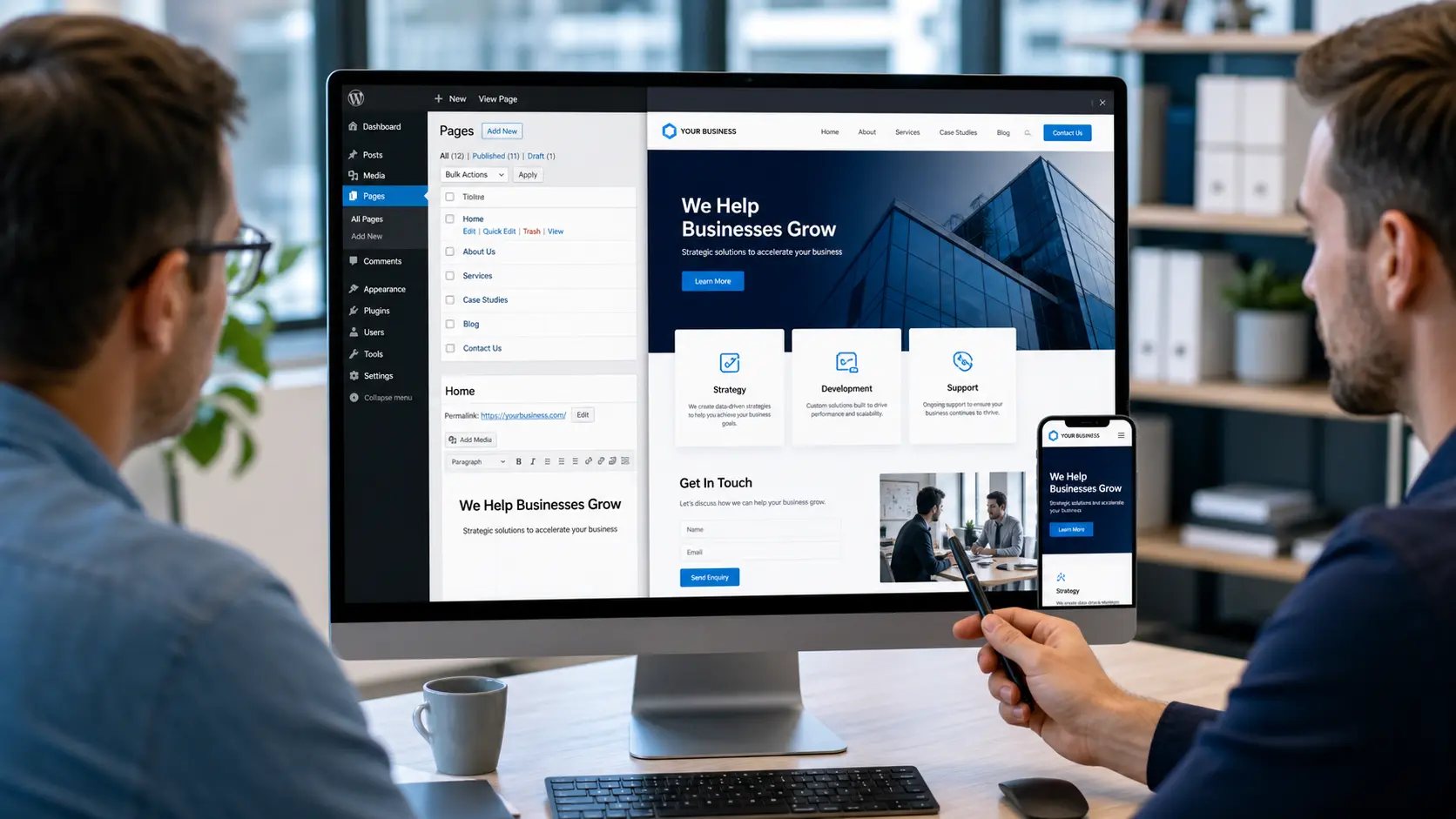
One of the biggest reasons businesses continue to choose WordPress is its content management capabilities. Business owners and marketing teams can update pages, publish blogs, replace images, edit service information, and manage website content without relying on a developer for every small change.
For small and medium-sized businesses, this flexibility is extremely valuable. A website should remain easy to maintain long after it has been launched.
When planned correctly, a WordPress business website offers an excellent balance of flexibility, affordability, and long-term scalability.
Ideal for Content-Driven Business Websites
WordPress works particularly well for websites that primarily focus on presenting information and generating enquiries.
Typical business websites built with WordPress include pages such as:
- Home
- About Us
- Services
- Products
- Blogs or News
- Case Studies
- Careers
- Contact Us
- Landing Pages
Businesses that regularly publish articles, project updates, company news, product information, or educational content benefit greatly from WordPress because content can be managed without technical knowledge.
From a business planning perspective, WordPress is an excellent choice when the primary goal is content presentation, trust-building, and enquiry generation.
Faster Development and Cost Efficiency
Compared to fully custom website development, WordPress can significantly reduce development time for standard business websites. Its ecosystem of themes, page builders, plugins, and built-in CMS features helps accelerate development while keeping costs manageable.
However, faster development should never mean compromising quality. A professional WordPress website still requires careful planning, clean design, organized content, proper SEO structure, performance optimization, and strong security practices.
A reliable WordPress development company helps businesses choose the right tools instead of simply installing numerous plugins or unnecessary features.
Plugins Should Be Chosen Carefully
One of WordPress’s greatest strengths is its plugin ecosystem. Plugins can add features such as contact forms, SEO tools, website security, backups, caching, analytics, WooCommerce functionality, and much more.
While plugins provide flexibility, installing too many of them can negatively impact website speed, compatibility, and long-term maintenance.
Every plugin should be selected based on genuine business requirements, ongoing developer support, compatibility with the website, and overall reliability. The objective is to build a stable website—not simply one with the largest number of features.
WordPress Provides a Strong SEO Foundation
When developed correctly, WordPress provides an excellent foundation for search engine optimization (SEO). It supports clean URLs, optimized page titles, meta descriptions, heading hierarchy, image alt attributes, XML sitemaps, and regular content publishing.
However, WordPress itself does not guarantee search rankings. High-quality content, website performance, technical optimization, user experience, and consistent SEO efforts all contribute to long-term results.
Think of WordPress as providing the right technical foundation—ongoing optimization is still necessary for strong search visibility.
Maintenance and Security Matter
Like any professional software platform, WordPress requires regular maintenance. Core updates, plugin updates, theme updates, security monitoring, backups, and performance checks should be part of an ongoing maintenance plan.
Many website issues occur not because WordPress is unreliable, but because websites are left without regular maintenance for long periods.
Businesses should treat website maintenance as an investment in security, reliability, and long-term performance—especially when handling enquiries, online payments, customer accounts, or important business information.
When Custom Development Is the Better Choice
Some projects extend far beyond traditional business websites. Applications involving custom dashboards, employee portals, CRM systems, ERP platforms, advanced user permissions, complex workflows, or high-performance web applications often require custom software development.
In these situations, technologies such as Laravel, ReactJS, Next.js, Node.js, REST APIs, or headless architectures may provide greater flexibility, scalability, and long-term control.
Combining WordPress with Custom Development
Choosing between WordPress and custom development is not always an either-or decision. Many successful projects combine both approaches.
For example, WordPress can manage website content while a custom application handles customer management, ERP integration, inventory systems, business workflows, or specialized dashboards. Headless WordPress is another option where WordPress serves as the content management system while a modern frontend delivers enhanced performance and user experience.
The best technology stack should always be determined by business requirements—not by current trends.
How to Decide If WordPress Is Right for Your Business
Before choosing a website platform, business owners should consider a few practical questions:
- Will your team regularly update website content?
- Is the website primarily informational or workflow-driven?
- Can the required functionality be achieved with reliable plugins?
- Will website performance and security remain manageable?
- Do you expect significant future expansion?
- What are your available budget and project timeline?
If your primary objective is presenting information, publishing content, and generating enquiries, WordPress is often an excellent choice. If your business depends on complex workflows, highly customized logic, or advanced business applications, custom development may provide greater long-term value.
Our Approach to WordPress Website Development
At Auspian Technologies, we recommend WordPress only when it genuinely aligns with your business objectives. If WordPress is the right fit, we build websites that are fast, secure, easy to manage, SEO-friendly, and designed to grow alongside your business.
When a project requires advanced workflows, custom portals, ERP or CRM integration, or enterprise-level functionality, we also develop tailored solutions using technologies such as Laravel, ReactJS, Next.js, Node.js, APIs, and other modern development frameworks.
Our focus is simple: choose the technology that best supports your business—not the one that is simply the most popular.
Frequently Asked Questions
1. Is WordPress good for business websites?
Yes. WordPress is an excellent choice for many business websites, including corporate websites, service websites, blogs, product catalogs, and landing pages. It offers flexibility, easy content management, and a strong foundation for future growth.
2. Can I update my WordPress website without a developer?
Yes. One of WordPress’s biggest advantages is its user-friendly content management system. Business owners and marketing teams can update pages, publish blogs, replace images, and manage content without technical expertise.
3. Is WordPress good for SEO?
WordPress provides an excellent technical foundation for SEO through clean URLs, optimized page structures, metadata, XML sitemaps, and content management. However, ongoing SEO success also depends on high-quality content, website performance, and continuous optimization.
4. When should I choose custom development instead of WordPress?
Custom development is often the better choice when your project requires advanced business workflows, custom dashboards, ERP or CRM integration, complex user roles, enterprise applications, or functionality that cannot be efficiently delivered through WordPress.
5. How often should a WordPress website be maintained?
WordPress websites should be maintained regularly by updating the WordPress core, themes, and plugins, monitoring security, creating backups, and testing website performance. Routine maintenance helps keep the website secure, reliable, and running efficiently.
Build a WordPress Website That Supports Your Business
If you’re planning a new WordPress website or upgrading an existing one, Auspian Technologies can help you create a solution that is professional, fast, secure, and easy to manage. We build WordPress websites that not only look great but also support your business goals, improve user experience, and simplify long-term content management.
Whether you need a corporate website, service website, product catalog, landing pages, or a custom WordPress solution with advanced integrations, our team can help you build a website designed for long-term growth.